
Blog
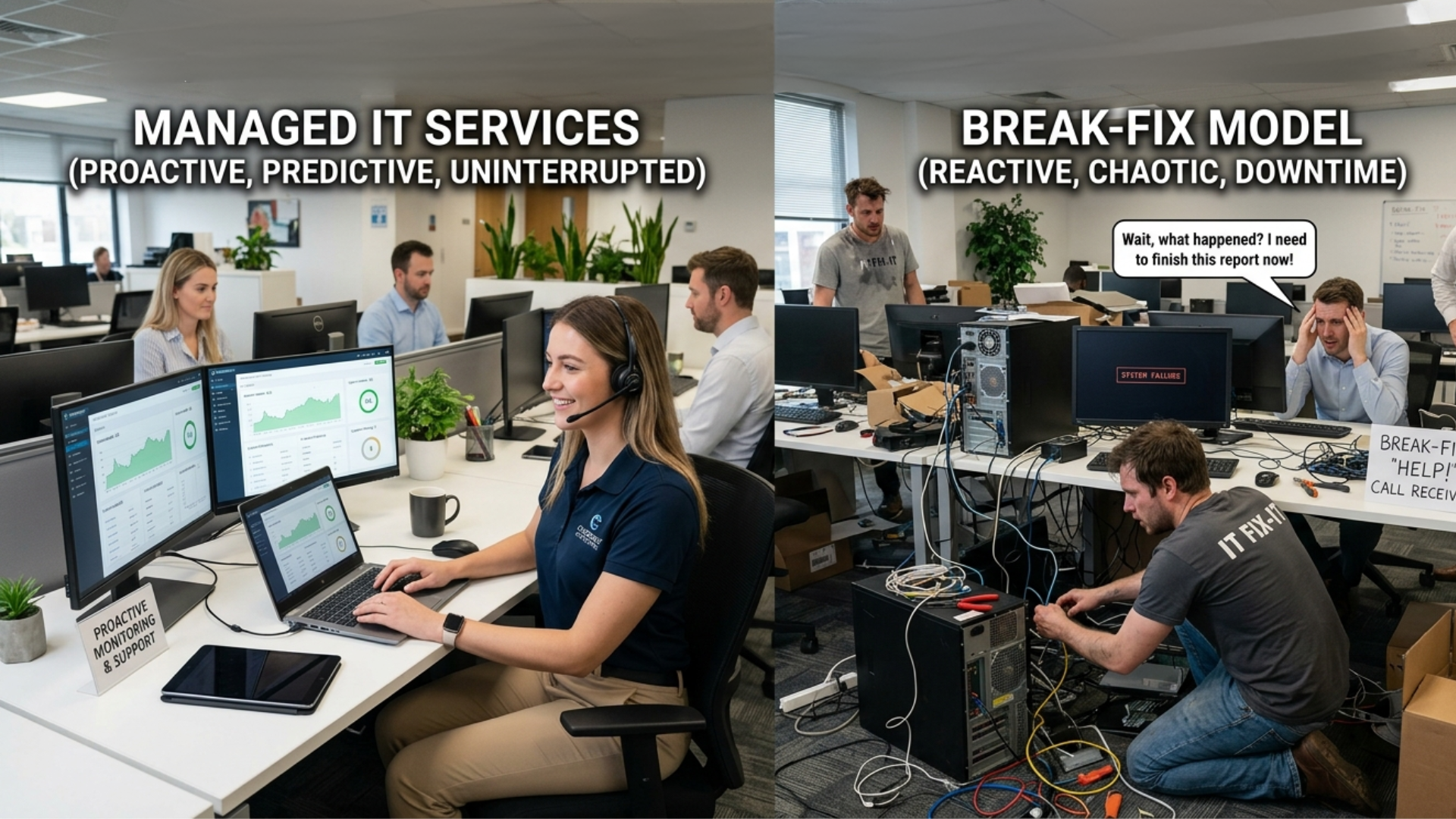
Managed IT vs. Break-Fix: What's the Real Difference (and Why It Matters for Your Business)?
If your company's IT strategy is basically "call someone when things go wrong," you're not alone. A lot of small and mid-sized businesses in Sacramento and beyond still run their technology this way. It feels simple. It feels affordable. And it works fine... right up until it doesn't.
There's actually a name for that approach: the break-fix model. And there's a reason most growing businesses eventually abandon it.
This post breaks down the core difference between managed IT and break-fix support, what each one actually costs you, and how to know which model your business really needs right now.
What Is Break-Fix IT Support?
Break-fix is exactly what it sounds like. Something breaks. You call someone to fix it. You pay for that visit or that hour. Then you move on until something breaks again.
It's a transactional relationship with no ongoing commitment from either side. The IT vendor has no stake in keeping your systems healthy because healthy systems mean they don't get paid. You have no predictability in your IT costs because every incident is a surprise bill.
Break-fix works the same way a mechanic works if you only took your car in after the engine seized. Technically, someone can help you. But you've already lost time, money, and trust in your vehicle.
Common characteristics of break-fix IT:
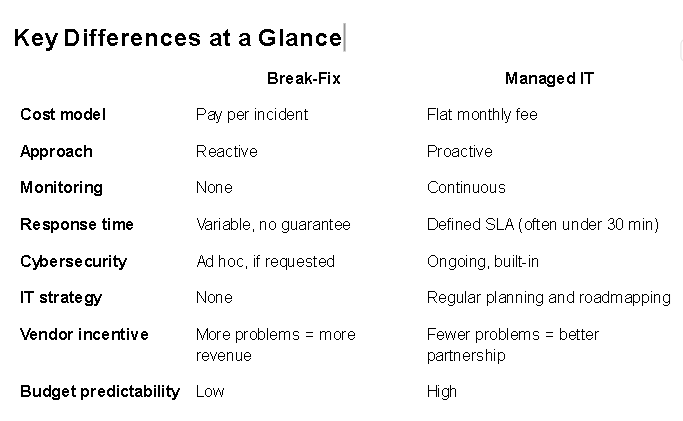
You pay per incident or per hour, usually with no retainer
Support is reactive, meaning help only arrives after a problem surfaces
No one is monitoring your systems in between calls
Response times vary widely and are rarely guaranteed
There's no documentation of your environment or strategic roadmap
For a solo freelancer or a two-person shop, this can work. But for businesses with employees depending on uptime, client data to protect, or any kind of compliance requirement, break-fix starts to show its cracks fast.
What Is Managed IT Support?
Managed IT, or a managed services model, is a proactive, ongoing partnership. Instead of calling for help after a disaster, you have a team continuously monitoring, maintaining, and securing your technology before things go wrong.
You pay a flat monthly fee (typically per user or per device) and in return, you get a defined set of services delivered consistently. Think of it less like a repairman and more like having your own IT department, without the overhead of hiring one in-house.
What managed IT typically includes:
24/7 or business-hours monitoring of your network, endpoints, and servers
Proactive patching and software updates to close security vulnerabilities
Help desk support with guaranteed response times (often under 30 minutes)
Cybersecurity tools like endpoint protection, managed firewalls, and threat detection
Strategic IT consulting and planning aligned with your business goals
Documentation of your systems, policies, and configurations
Backup and disaster recovery management
The core idea is that your IT partner's job is to prevent problems, not profit from them. That's a fundamentally different incentive structure, and it changes the entire relationship.
The Real Cost Comparison: Break-Fix vs. Managed IT
One of the biggest myths about break-fix is that it's cheaper. On paper, you're only paying when something happens. In practice, here's what that math often ignores.
Downtime is brutally expensive. A single server outage or ransomware attack can cost a small business thousands of dollars per hour in lost productivity. When you're on break-fix, you're waiting for a tech to become available, diagnose the problem, and fix it cold, with no prior knowledge of your environment. That process takes time.
Break-fix bills spike unpredictably. A slow quarter might have you paying almost nothing. Then a bad month rolls around and you're hit with three separate incidents, each billed at emergency rates. Your finance team cannot budget for IT when every line item is a surprise.
Reactive IT misses the expensive problems. The failures that cost the most, like data breaches, hardware failures, and ransomware, almost always have warning signs that go undetected without monitoring. A managed IT provider catches those signals. A break-fix technician never sees them because no one was looking.
Cybersecurity is not a one-time fix. The threat landscape changes daily. Break-fix IT typically does not include ongoing security management. That gap leaves your business exposed to attacks that a managed provider would actively work to prevent.
Managed IT pricing, by contrast, is predictable. You know what you're paying every month, what's included, and who to call. Most businesses find that the total cost of managed IT, when stacked against the real cost of downtime, emergency repairs, and reactive security incidents, actually comes out lower over 12 months.
Which Model Is Right for Your Business?
Break-fix might still make sense if your business has very few devices, no sensitive data, no employees depending on uptime, and no compliance requirements. But that describes a shrinking number of businesses.
Ask yourself these questions:
1. Do you have employees who can't do their jobs when IT goes down? If the answer is yes, every hour of downtime has a dollar value attached to it. Managed IT is designed to minimize those hours.
2. Do you store or handle sensitive client data? HIPAA, PCI-DSS, state privacy laws, and industry regulations are not optional. Managed IT providers help you stay compliant and document it. Break-fix does not.
3. Have you experienced a security incident in the last two years? If you've dealt with a phishing attack, ransomware, or data breach, the reactive approach has already cost you. Managed IT exists to stop the next one before it starts.
4. Is your IT spending unpredictable month to month? If you can't forecast your IT costs, you're likely on break-fix or a loose support arrangement. Managed IT gives you a number you can put in your budget and count on.
5. Do you have a plan for what happens if your server dies tomorrow? A managed IT partner maintains your backup, tests your recovery process, and documents your systems. Break-fix vendors are starting from scratch every time.
Why Businesses Switch to Managed IT
The conversation usually starts after something goes wrong. A ransomware attack. A compliance audit that surfaces gaps. A long outage that costs real money. A key employee who couldn't work for two days because a laptop issue sat in a queue.
But the businesses that make the switch proactively, before the disaster, are the ones that come out ahead. They get ahead of security gaps, they stop paying emergency rates, and they stop treating IT as a problem to react to and start treating it as an asset to invest in.
At Total Secure Technology, we work with Sacramento businesses that are ready to make that shift. Our Security-First IT approach means cybersecurity is not an add-on, it's built into everything we do. And with response times under 30 minutes and a 97.7% client satisfaction rating, we're not just a vendor. We're your IT department.
Ready to Move Beyond Break-Fix?
If you're still running on a reactive IT model and wondering whether there's a better way, there is. And it doesn't have to be complicated to get started.
Schedule a call with our team, and we'll walk you through exactly what managed IT would look like for your business, with no pressure and no jargon.
Or call us directly at (916) 634-0593 for sales inquiries.
Total Secure Technology | Sacramento Managed IT Services and Cybersecurity totalsecuretech.com

schedule an appointment today
Enter your name and email to get started today.
Featured Posts
Managed IT vs. Break-Fix: What's the Real Difference (and Why It Matters for Your Business)?
If your company's IT strategy is basically "call someone when things go wrong," you're not alone. A lot of small and mid-sized businesses in Sacramento and beyond still run their technology this way. It feels simple. It feels affordable. And it works fine... right up until it doesn't.
There's actually a name for that approach: the break-fix model. And there's a reason most growing businesses eventually abandon it.
This post breaks down the core difference between managed IT and break-fix support, what each one actually costs you, and how to know which model your business really needs right now.
What Is Break-Fix IT Support?
Break-fix is exactly what it sounds like. Something breaks. You call someone to fix it. You pay for that visit or that hour. Then you move on until something breaks again.
It's a transactional relationship with no ongoing commitment from either side. The IT vendor has no stake in keeping your systems healthy because healthy systems mean they don't get paid. You have no predictability in your IT costs because every incident is a surprise bill.
Break-fix works the same way a mechanic works if you only took your car in after the engine seized. Technically, someone can help you. But you've already lost time, money, and trust in your vehicle.
Common characteristics of break-fix IT:
You pay per incident or per hour, usually with no retainer
Support is reactive, meaning help only arrives after a problem surfaces
No one is monitoring your systems in between calls
Response times vary widely and are rarely guaranteed
There's no documentation of your environment or strategic roadmap
For a solo freelancer or a two-person shop, this can work. But for businesses with employees depending on uptime, client data to protect, or any kind of compliance requirement, break-fix starts to show its cracks fast.
What Is Managed IT Support?
Managed IT, or a managed services model, is a proactive, ongoing partnership. Instead of calling for help after a disaster, you have a team continuously monitoring, maintaining, and securing your technology before things go wrong.
You pay a flat monthly fee (typically per user or per device) and in return, you get a defined set of services delivered consistently. Think of it less like a repairman and more like having your own IT department, without the overhead of hiring one in-house.
What managed IT typically includes:
24/7 or business-hours monitoring of your network, endpoints, and servers
Proactive patching and software updates to close security vulnerabilities
Help desk support with guaranteed response times (often under 30 minutes)
Cybersecurity tools like endpoint protection, managed firewalls, and threat detection
Strategic IT consulting and planning aligned with your business goals
Documentation of your systems, policies, and configurations
Backup and disaster recovery management
The core idea is that your IT partner's job is to prevent problems, not profit from them. That's a fundamentally different incentive structure, and it changes the entire relationship.
The Real Cost Comparison: Break-Fix vs. Managed IT
One of the biggest myths about break-fix is that it's cheaper. On paper, you're only paying when something happens. In practice, here's what that math often ignores.
Downtime is brutally expensive. A single server outage or ransomware attack can cost a small business thousands of dollars per hour in lost productivity. When you're on break-fix, you're waiting for a tech to become available, diagnose the problem, and fix it cold, with no prior knowledge of your environment. That process takes time.
Break-fix bills spike unpredictably. A slow quarter might have you paying almost nothing. Then a bad month rolls around and you're hit with three separate incidents, each billed at emergency rates. Your finance team cannot budget for IT when every line item is a surprise.
Reactive IT misses the expensive problems. The failures that cost the most, like data breaches, hardware failures, and ransomware, almost always have warning signs that go undetected without monitoring. A managed IT provider catches those signals. A break-fix technician never sees them because no one was looking.
Cybersecurity is not a one-time fix. The threat landscape changes daily. Break-fix IT typically does not include ongoing security management. That gap leaves your business exposed to attacks that a managed provider would actively work to prevent.
Managed IT pricing, by contrast, is predictable. You know what you're paying every month, what's included, and who to call. Most businesses find that the total cost of managed IT, when stacked against the real cost of downtime, emergency repairs, and reactive security incidents, actually comes out lower over 12 months.
Which Model Is Right for Your Business?
Break-fix might still make sense if your business has very few devices, no sensitive data, no employees depending on uptime, and no compliance requirements. But that describes a shrinking number of businesses.
Ask yourself these questions:
1. Do you have employees who can't do their jobs when IT goes down? If the answer is yes, every hour of downtime has a dollar value attached to it. Managed IT is designed to minimize those hours.
2. Do you store or handle sensitive client data? HIPAA, PCI-DSS, state privacy laws, and industry regulations are not optional. Managed IT providers help you stay compliant and document it. Break-fix does not.
3. Have you experienced a security incident in the last two years? If you've dealt with a phishing attack, ransomware, or data breach, the reactive approach has already cost you. Managed IT exists to stop the next one before it starts.
4. Is your IT spending unpredictable month to month? If you can't forecast your IT costs, you're likely on break-fix or a loose support arrangement. Managed IT gives you a number you can put in your budget and count on.
5. Do you have a plan for what happens if your server dies tomorrow? A managed IT partner maintains your backup, tests your recovery process, and documents your systems. Break-fix vendors are starting from scratch every time.
Why Businesses Switch to Managed IT
The conversation usually starts after something goes wrong. A ransomware attack. A compliance audit that surfaces gaps. A long outage that costs real money. A key employee who couldn't work for two days because a laptop issue sat in a queue.
But the businesses that make the switch proactively, before the disaster, are the ones that come out ahead. They get ahead of security gaps, they stop paying emergency rates, and they stop treating IT as a problem to react to and start treating it as an asset to invest in.
At Total Secure Technology, we work with Sacramento businesses that are ready to make that shift. Our Security-First IT approach means cybersecurity is not an add-on, it's built into everything we do. And with response times under 30 minutes and a 97.7% client satisfaction rating, we're not just a vendor. We're your IT department.
Ready to Move Beyond Break-Fix?
If you're still running on a reactive IT model and wondering whether there's a better way, there is. And it doesn't have to be complicated to get started.
Schedule a call with our team, and we'll walk you through exactly what managed IT would look like for your business, with no pressure and no jargon.
Or call us directly at (916) 634-0593 for sales inquiries.
Total Secure Technology | Sacramento Managed IT Services and Cybersecurity totalsecuretech.com
Subscribe to Our Newsletter
Ready to Take IT Off Your Worry List?
Schedule your IT strategy session today.

Headquarters
Sacramento Office
3284 Ramos Cir, Sacramento, CA 95827
Cheyenne Office
1621 Central Ave #8788 Cheyenne, WY 82001
© 2026 Total Secure Technology. All Rights Reserved. Built in partnership with Tech Pro Marketing. | Areas We Serve | Privacy Policy | Terms