
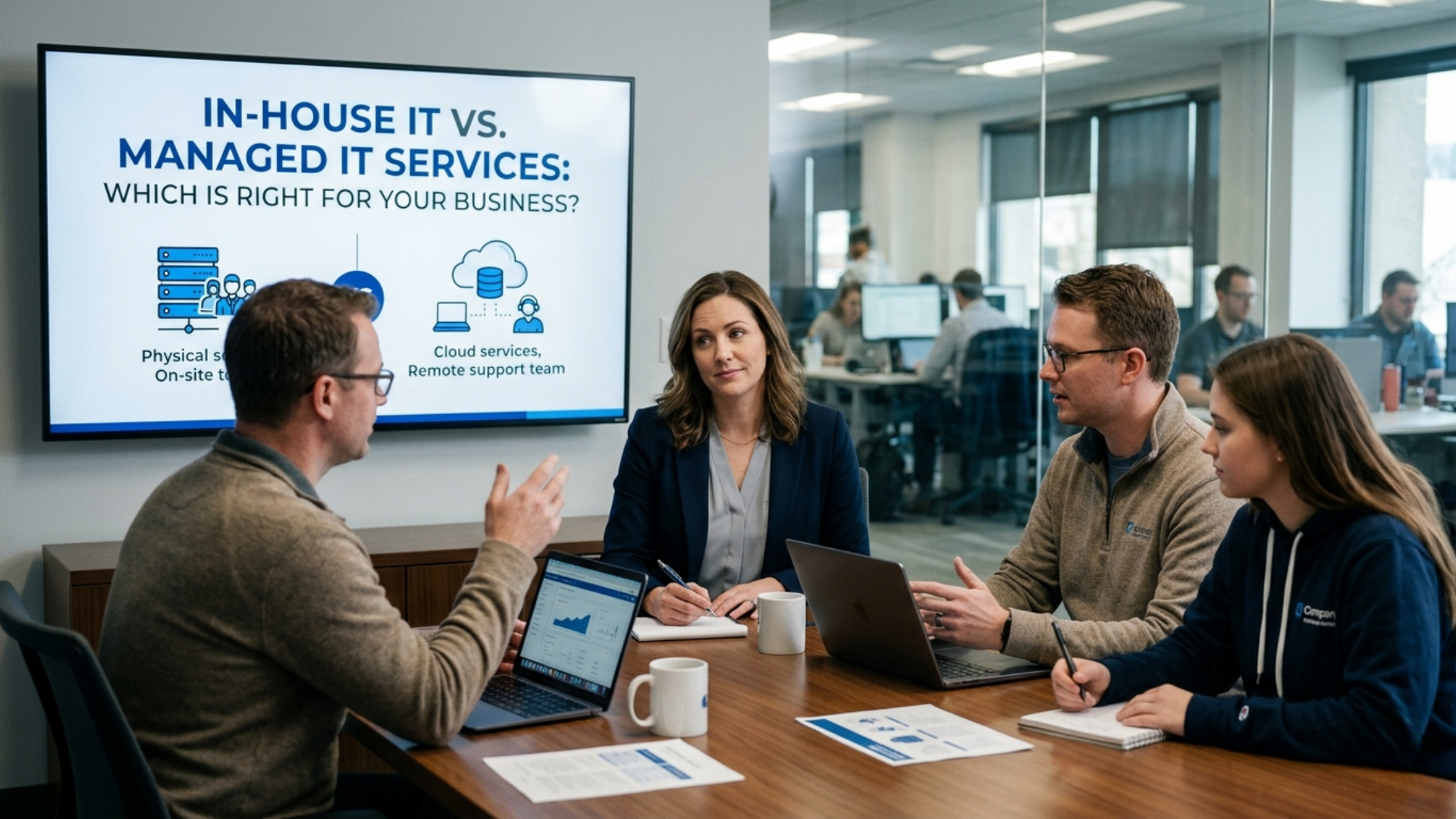
In-House IT vs. Managed IT Services: Which Is Right for Your Business?
Every business eventually hits the same fork in the road. Your technology is growing faster than your team can handle it. Something breaks on a Friday afternoon. Nobody's sure who owns the fix. And somewhere in the back of your mind, a nagging question starts to take shape: Should we be doing this differently?
That question almost always leads to the same comparison: in-house IT vs. managed IT services (also called outsourced IT support). Both paths can work. But one of them is almost certainly a better fit for where your business is right now, and where it's headed.
This guide breaks down both models with honesty, clarity, and no jargon overload, so you can make a confident decision.
What Is In-House IT?
In-house IT means hiring your own full-time employees to manage your technology infrastructure. They sit inside your organization, attend your team meetings, know your people, and handle everything from password resets to cybersecurity policy.
It feels like the obvious choice when a company starts growing. You want control. You want someone available. You want IT to feel like part of the business, not a vendor on the other end of a phone.
That instinct makes sense. But the reality of running an internal IT department is a lot more complicated than it looks on paper.
What Are Managed IT Services?
Managed IT services (also referred to as outsourced IT support) means partnering with a third-party provider, called a Managed Service Provider or MSP, to handle some or all of your IT functions. This can include help desk support, cybersecurity, cloud management, network monitoring, compliance, backups, and more.
You pay a predictable monthly fee. They become your IT department, or they supplement the one you already have.
Good MSPs like Total Secure Technology operate proactively, meaning they work to prevent problems rather than just reacting when something breaks. That distinction matters more than most business owners realize until they've lived through a data breach or a 48-hour outage.
The Real Cost Comparison
Let's put some numbers on the table, because this is where most conversations either get real or fall apart.
In-House IT: What You're Actually Paying For
A single mid-level IT generalist in the United States earns between $60,000 and $90,000 per year in base salary. But that's only the beginning of the cost:
Employer payroll taxes (roughly 7.65%)
Health insurance and benefits (often $6,000 to $15,000+ per year per employee)
Paid time off, holidays, sick days
Training, certifications, and ongoing education
Recruitment costs when they leave (and turnover in IT is high)
Downtime when they're unavailable, whether that's vacation, illness, or burnout
When you factor all of that in, a single IT employee often costs the business $100,000 to $130,000 or more per year in true loaded cost. And one person can only know so much. A generalist who handles your help desk probably doesn't have deep expertise in cloud architecture, compliance frameworks, or advanced threat detection.
If you want real depth of knowledge across all IT disciplines, you need multiple people. That math gets expensive fast.
Managed IT Services: What You're Actually Getting
A managed service provider spreads their team's expertise across many clients. That pooling of resources means you get access to specialists in cybersecurity, networking, cloud, compliance, and more, without paying to hire each of them individually.
Most SMBs pay anywhere from $1,000 to $5,000+ per month for fully managed IT services, depending on the size of their environment and the scope of services. That translates to $12,000 to $60,000 per year.
Compare that to the $100,000+ cost of a single in-house employee. For the same budget, or often less, you can have an entire team of specialists working on your behalf.
The cost advantage for small to mid-sized businesses is not subtle. It is significant.
Coverage, Availability, and Response Time
Here's a scenario that plays out in businesses every week: it's 11 PM on a Sunday. A ransomware alert fires. Who answers?
With in-house IT, the answer is probably: nobody, or a very tired, very resentful employee who is technically on call.
With a quality managed IT provider, the answer is: someone who is monitoring your environment around the clock, who can begin responding before you even know there's a problem.
24/7 monitoring and response is standard with most managed IT service agreements. It's the exception with in-house IT unless you're large enough to run full shift coverage, which brings you back to the staffing cost problem.
Depth of Expertise
Technology in 2024 and beyond is not a single discipline. It's a constellation of specializations:
Endpoint security and antivirus management
Firewall and network infrastructure
Cloud platforms (Microsoft Azure, AWS, Google Cloud)
Compliance frameworks (HIPAA, PCI-DSS, SOC 2, CMMC)
Microsoft 365 and Google Workspace administration
Backup and disaster recovery
Vulnerability assessments and penetration testing
No single person masters all of these things. The most talented IT generalist still has gaps. An MSP fields a team with genuine depth across all of these areas, with specialists who work in these domains every single day across dozens or hundreds of client environments.
That breadth of exposure actually makes MSPs better at solving problems. When a managed service provider has seen a particular configuration issue or threat pattern across 50 different organizations, they solve it faster and smarter than someone encountering it for the first time.
Control and Customization
This is the most common objection to outsourced IT support, and it's worth taking seriously.
Business owners who prefer in-house IT usually say some version of the same thing: I want someone who knows our systems, our people, and our priorities. I don't want to feel like just another ticket in someone else's queue.
That concern is valid. And it's also solvable.
The best managed IT providers operate as a genuine extension of your team. They learn your environment thoroughly. They align their priorities with yours. They communicate proactively, not just when something breaks. They assign dedicated contacts, not random support agents.
The key is choosing the right partner. A good MSP feels like an in-house team. A bad one feels exactly like the impersonal help desk you're afraid of. Total Secure Technology is built around the partnership model, where your business goals drive how IT gets managed, not the other way around.
Scalability: Who Wins When You Grow?
Imagine your company doubles in size over the next 18 months. What does that mean for IT?
With in-house IT, it means recruiting, hiring, onboarding, and training more staff. That process takes months and costs money, whether or not the growth sustains itself.
With managed IT services, scaling up is usually as simple as adjusting your service agreement. More users, more devices, more locations. The infrastructure to support that growth already exists within the MSP's team.
The same logic works in reverse. If business contracts, you're not stuck with an in-house headcount that no longer fits your budget.
Managed IT is inherently elastic. In-house IT is inherently rigid.
Cybersecurity: Where the Stakes Are Highest
The cybersecurity landscape has changed dramatically, and most small to mid-sized businesses are not keeping pace. According to industry reports, SMBs represent the majority of cyberattack targets precisely because attackers know that smaller organizations often lack the defenses that enterprise companies maintain.
In-house IT generalists are often stretched too thin to stay current on evolving threats. Cybersecurity is a full-time specialization, and treating it as a side function of someone whose main job is keeping the Wi-Fi running is a risk most organizations can't afford to take.
Managed security services bring dedicated expertise: threat monitoring, vulnerability scanning, incident response planning, employee security awareness training, and much more. It's not just reactive. It's a posture.
This matters especially in regulated industries. Healthcare organizations under HIPAA, financial firms under various compliance regimes, and government contractors under CMMC requirements cannot treat cybersecurity as an afterthought. Outsourced IT support from a provider with compliance expertise is often the only realistic path to meeting those obligations without building an internal security team from scratch.
When In-House IT Does Make Sense
To be fair, there are situations where building an internal IT team is the right call.
Large enterprise organizations with thousands of employees, highly complex proprietary systems, or unique regulatory environments may genuinely need dedicated internal staff who live inside the business full-time. At enterprise scale, the economics shift and internal IT can actually be cost-competitive.
Businesses with highly specialized legacy systems that require deep institutional knowledge may struggle to hand that over to an outside provider, at least without a significant transition investment.
Organizations with strict data sovereignty requirements, where any external access to systems is restricted by contract or regulation, may have limited options for outsourcing.
Even in these cases, many large organizations use a hybrid model: a small in-house IT leadership team that manages strategy and vendor relationships, supported by managed services for execution-level work.
When Managed IT Services Are the Clear Choice
For most small to mid-sized businesses, managed IT services is the right answer. Specifically, if any of the following describe your situation, outsourced IT support deserves serious consideration:
You have fewer than 200 employees. The math on building a capable in-house IT team rarely works at this scale.
Your current IT support is reactive. If your approach to IT is basically "wait for something to break and then fix it," you're accumulating risk with every passing month.
You've experienced a security incident or near-miss. One breach is expensive. A second one, after you already knew there was a problem, is inexcusable.
You're spending unpredictably on IT. Managed services turn erratic, hard-to-budget IT costs into a consistent monthly line item.
You're not confident about your compliance posture. Regulatory risk is business risk. An MSP with compliance expertise is a significant asset.
Your team is stretched thin. If your "IT person" is actually a business owner, an office manager, or an accountant who also handles tech questions, that's not a sustainable model.
The Hybrid Approach: Getting the Best of Both
It's worth noting that the choice between in-house IT and managed IT services doesn't have to be binary.
Many businesses successfully run a co-managed IT model. They might have one or two internal IT staff members who handle day-to-day user support and understand the business deeply, backed by an MSP that provides the security monitoring, specialized expertise, and after-hours coverage that the internal team can't realistically provide alone.
This model gives you the relational benefits of an in-house presence with the depth and scalability of managed services. It's increasingly popular, and it's an option worth exploring if you already have IT staff but feel like the gaps are growing.
Questions to Ask Before You Decide
Before committing to either model, work through these questions honestly:
What does a major IT failure actually cost our business, in lost revenue, productivity, and reputation?
Do we have the right cybersecurity capabilities to protect against today's threats?
Are we compliant with the regulations that apply to our industry?
Can we recruit and retain the specialized IT talent we actually need?
What are we currently spending on IT, and is that number predictable?
If our IT person left tomorrow, what would happen?
The answers to those questions will point you toward the right choice more clearly than any comparison chart.
Making the Transition to Managed IT Services
If you've decided that outsourced IT support is the direction you want to go, the transition is more straightforward than most people expect, especially when the MSP has experience managing migrations.
A good managed service provider will start with a thorough assessment of your current environment: your hardware, software, security posture, backup status, and compliance gaps. From there, they'll build a roadmap for getting your environment where it needs to be, and then they take responsibility for keeping it there.
The onboarding process typically takes a few weeks, and most businesses report that the visible improvement in responsiveness and reliability is noticeable within the first month.
Why Total Secure Technology
Total Secure Technology provides managed IT services built for businesses that take their technology seriously. From cybersecurity and compliance to cloud management and help desk support, the team brings the depth of an enterprise IT department to organizations that need results without the overhead of building one internally.
If you're evaluating your IT options and want a straightforward conversation about what the right model looks like for your specific situation, that is exactly the kind of conversation Total Secure Technology is built for.
No pressure. No jargon. Just clarity.
The Bottom Line
In-house IT and managed IT services are not equal paths for most businesses. The perception that keeping IT internal means more control, better service, and a closer relationship with technology is understandable, but it rarely holds up against the numbers or the reality of what modern IT management actually requires.
For the majority of small and mid-sized businesses, managed IT services deliver better coverage, deeper expertise, stronger security, and more predictable costs than an in-house team of comparable investment could provide.
The question is not really "in-house vs. outsourced." The question is: what does your business actually need, and what is the most intelligent way to get it?
If you're ready to find out, Total Secure Technology is a good place to start.

schedule an appointment today
Enter your name and email to get started today.
Featured Posts
In-House IT vs. Managed IT Services: Which Is Right for Your Business?
Every business eventually hits the same fork in the road. Your technology is growing faster than your team can handle it. Something breaks on a Friday afternoon. Nobody's sure who owns the fix. And somewhere in the back of your mind, a nagging question starts to take shape: Should we be doing this differently?
That question almost always leads to the same comparison: in-house IT vs. managed IT services (also called outsourced IT support). Both paths can work. But one of them is almost certainly a better fit for where your business is right now, and where it's headed.
This guide breaks down both models with honesty, clarity, and no jargon overload, so you can make a confident decision.
What Is In-House IT?
In-house IT means hiring your own full-time employees to manage your technology infrastructure. They sit inside your organization, attend your team meetings, know your people, and handle everything from password resets to cybersecurity policy.
It feels like the obvious choice when a company starts growing. You want control. You want someone available. You want IT to feel like part of the business, not a vendor on the other end of a phone.
That instinct makes sense. But the reality of running an internal IT department is a lot more complicated than it looks on paper.
What Are Managed IT Services?
Managed IT services (also referred to as outsourced IT support) means partnering with a third-party provider, called a Managed Service Provider or MSP, to handle some or all of your IT functions. This can include help desk support, cybersecurity, cloud management, network monitoring, compliance, backups, and more.
You pay a predictable monthly fee. They become your IT department, or they supplement the one you already have.
Good MSPs like Total Secure Technology operate proactively, meaning they work to prevent problems rather than just reacting when something breaks. That distinction matters more than most business owners realize until they've lived through a data breach or a 48-hour outage.
The Real Cost Comparison
Let's put some numbers on the table, because this is where most conversations either get real or fall apart.
In-House IT: What You're Actually Paying For
A single mid-level IT generalist in the United States earns between $60,000 and $90,000 per year in base salary. But that's only the beginning of the cost:
Employer payroll taxes (roughly 7.65%)
Health insurance and benefits (often $6,000 to $15,000+ per year per employee)
Paid time off, holidays, sick days
Training, certifications, and ongoing education
Recruitment costs when they leave (and turnover in IT is high)
Downtime when they're unavailable, whether that's vacation, illness, or burnout
When you factor all of that in, a single IT employee often costs the business $100,000 to $130,000 or more per year in true loaded cost. And one person can only know so much. A generalist who handles your help desk probably doesn't have deep expertise in cloud architecture, compliance frameworks, or advanced threat detection.
If you want real depth of knowledge across all IT disciplines, you need multiple people. That math gets expensive fast.
Managed IT Services: What You're Actually Getting
A managed service provider spreads their team's expertise across many clients. That pooling of resources means you get access to specialists in cybersecurity, networking, cloud, compliance, and more, without paying to hire each of them individually.
Most SMBs pay anywhere from $1,000 to $5,000+ per month for fully managed IT services, depending on the size of their environment and the scope of services. That translates to $12,000 to $60,000 per year.
Compare that to the $100,000+ cost of a single in-house employee. For the same budget, or often less, you can have an entire team of specialists working on your behalf.
The cost advantage for small to mid-sized businesses is not subtle. It is significant.
Coverage, Availability, and Response Time
Here's a scenario that plays out in businesses every week: it's 11 PM on a Sunday. A ransomware alert fires. Who answers?
With in-house IT, the answer is probably: nobody, or a very tired, very resentful employee who is technically on call.
With a quality managed IT provider, the answer is: someone who is monitoring your environment around the clock, who can begin responding before you even know there's a problem.
24/7 monitoring and response is standard with most managed IT service agreements. It's the exception with in-house IT unless you're large enough to run full shift coverage, which brings you back to the staffing cost problem.
Depth of Expertise
Technology in 2024 and beyond is not a single discipline. It's a constellation of specializations:
Endpoint security and antivirus management
Firewall and network infrastructure
Cloud platforms (Microsoft Azure, AWS, Google Cloud)
Compliance frameworks (HIPAA, PCI-DSS, SOC 2, CMMC)
Microsoft 365 and Google Workspace administration
Backup and disaster recovery
Vulnerability assessments and penetration testing
No single person masters all of these things. The most talented IT generalist still has gaps. An MSP fields a team with genuine depth across all of these areas, with specialists who work in these domains every single day across dozens or hundreds of client environments.
That breadth of exposure actually makes MSPs better at solving problems. When a managed service provider has seen a particular configuration issue or threat pattern across 50 different organizations, they solve it faster and smarter than someone encountering it for the first time.
Control and Customization
This is the most common objection to outsourced IT support, and it's worth taking seriously.
Business owners who prefer in-house IT usually say some version of the same thing: I want someone who knows our systems, our people, and our priorities. I don't want to feel like just another ticket in someone else's queue.
That concern is valid. And it's also solvable.
The best managed IT providers operate as a genuine extension of your team. They learn your environment thoroughly. They align their priorities with yours. They communicate proactively, not just when something breaks. They assign dedicated contacts, not random support agents.
The key is choosing the right partner. A good MSP feels like an in-house team. A bad one feels exactly like the impersonal help desk you're afraid of. Total Secure Technology is built around the partnership model, where your business goals drive how IT gets managed, not the other way around.
Scalability: Who Wins When You Grow?
Imagine your company doubles in size over the next 18 months. What does that mean for IT?
With in-house IT, it means recruiting, hiring, onboarding, and training more staff. That process takes months and costs money, whether or not the growth sustains itself.
With managed IT services, scaling up is usually as simple as adjusting your service agreement. More users, more devices, more locations. The infrastructure to support that growth already exists within the MSP's team.
The same logic works in reverse. If business contracts, you're not stuck with an in-house headcount that no longer fits your budget.
Managed IT is inherently elastic. In-house IT is inherently rigid.
Cybersecurity: Where the Stakes Are Highest
The cybersecurity landscape has changed dramatically, and most small to mid-sized businesses are not keeping pace. According to industry reports, SMBs represent the majority of cyberattack targets precisely because attackers know that smaller organizations often lack the defenses that enterprise companies maintain.
In-house IT generalists are often stretched too thin to stay current on evolving threats. Cybersecurity is a full-time specialization, and treating it as a side function of someone whose main job is keeping the Wi-Fi running is a risk most organizations can't afford to take.
Managed security services bring dedicated expertise: threat monitoring, vulnerability scanning, incident response planning, employee security awareness training, and much more. It's not just reactive. It's a posture.
This matters especially in regulated industries. Healthcare organizations under HIPAA, financial firms under various compliance regimes, and government contractors under CMMC requirements cannot treat cybersecurity as an afterthought. Outsourced IT support from a provider with compliance expertise is often the only realistic path to meeting those obligations without building an internal security team from scratch.
When In-House IT Does Make Sense
To be fair, there are situations where building an internal IT team is the right call.
Large enterprise organizations with thousands of employees, highly complex proprietary systems, or unique regulatory environments may genuinely need dedicated internal staff who live inside the business full-time. At enterprise scale, the economics shift and internal IT can actually be cost-competitive.
Businesses with highly specialized legacy systems that require deep institutional knowledge may struggle to hand that over to an outside provider, at least without a significant transition investment.
Organizations with strict data sovereignty requirements, where any external access to systems is restricted by contract or regulation, may have limited options for outsourcing.
Even in these cases, many large organizations use a hybrid model: a small in-house IT leadership team that manages strategy and vendor relationships, supported by managed services for execution-level work.
When Managed IT Services Are the Clear Choice
For most small to mid-sized businesses, managed IT services is the right answer. Specifically, if any of the following describe your situation, outsourced IT support deserves serious consideration:
You have fewer than 200 employees. The math on building a capable in-house IT team rarely works at this scale.
Your current IT support is reactive. If your approach to IT is basically "wait for something to break and then fix it," you're accumulating risk with every passing month.
You've experienced a security incident or near-miss. One breach is expensive. A second one, after you already knew there was a problem, is inexcusable.
You're spending unpredictably on IT. Managed services turn erratic, hard-to-budget IT costs into a consistent monthly line item.
You're not confident about your compliance posture. Regulatory risk is business risk. An MSP with compliance expertise is a significant asset.
Your team is stretched thin. If your "IT person" is actually a business owner, an office manager, or an accountant who also handles tech questions, that's not a sustainable model.
The Hybrid Approach: Getting the Best of Both
It's worth noting that the choice between in-house IT and managed IT services doesn't have to be binary.
Many businesses successfully run a co-managed IT model. They might have one or two internal IT staff members who handle day-to-day user support and understand the business deeply, backed by an MSP that provides the security monitoring, specialized expertise, and after-hours coverage that the internal team can't realistically provide alone.
This model gives you the relational benefits of an in-house presence with the depth and scalability of managed services. It's increasingly popular, and it's an option worth exploring if you already have IT staff but feel like the gaps are growing.
Questions to Ask Before You Decide
Before committing to either model, work through these questions honestly:
What does a major IT failure actually cost our business, in lost revenue, productivity, and reputation?
Do we have the right cybersecurity capabilities to protect against today's threats?
Are we compliant with the regulations that apply to our industry?
Can we recruit and retain the specialized IT talent we actually need?
What are we currently spending on IT, and is that number predictable?
If our IT person left tomorrow, what would happen?
The answers to those questions will point you toward the right choice more clearly than any comparison chart.
Making the Transition to Managed IT Services
If you've decided that outsourced IT support is the direction you want to go, the transition is more straightforward than most people expect, especially when the MSP has experience managing migrations.
A good managed service provider will start with a thorough assessment of your current environment: your hardware, software, security posture, backup status, and compliance gaps. From there, they'll build a roadmap for getting your environment where it needs to be, and then they take responsibility for keeping it there.
The onboarding process typically takes a few weeks, and most businesses report that the visible improvement in responsiveness and reliability is noticeable within the first month.
Why Total Secure Technology
Total Secure Technology provides managed IT services built for businesses that take their technology seriously. From cybersecurity and compliance to cloud management and help desk support, the team brings the depth of an enterprise IT department to organizations that need results without the overhead of building one internally.
If you're evaluating your IT options and want a straightforward conversation about what the right model looks like for your specific situation, that is exactly the kind of conversation Total Secure Technology is built for.
No pressure. No jargon. Just clarity.
The Bottom Line
In-house IT and managed IT services are not equal paths for most businesses. The perception that keeping IT internal means more control, better service, and a closer relationship with technology is understandable, but it rarely holds up against the numbers or the reality of what modern IT management actually requires.
For the majority of small and mid-sized businesses, managed IT services deliver better coverage, deeper expertise, stronger security, and more predictable costs than an in-house team of comparable investment could provide.
The question is not really "in-house vs. outsourced." The question is: what does your business actually need, and what is the most intelligent way to get it?
If you're ready to find out, Total Secure Technology is a good place to start.
Subscribe to Our Newsletter
Ready to Take IT Off Your Worry List?
Schedule your IT strategy session today.

Headquarters
Sacramento Office
3284 Ramos Cir, Sacramento, CA 95827
Cheyenne Office
1621 Central Ave #8788 Cheyenne, WY 82001
© 2026 Total Secure Technology. All Rights Reserved. Built in partnership with Tech Pro Marketing. | Areas We Serve | Privacy Policy | Terms